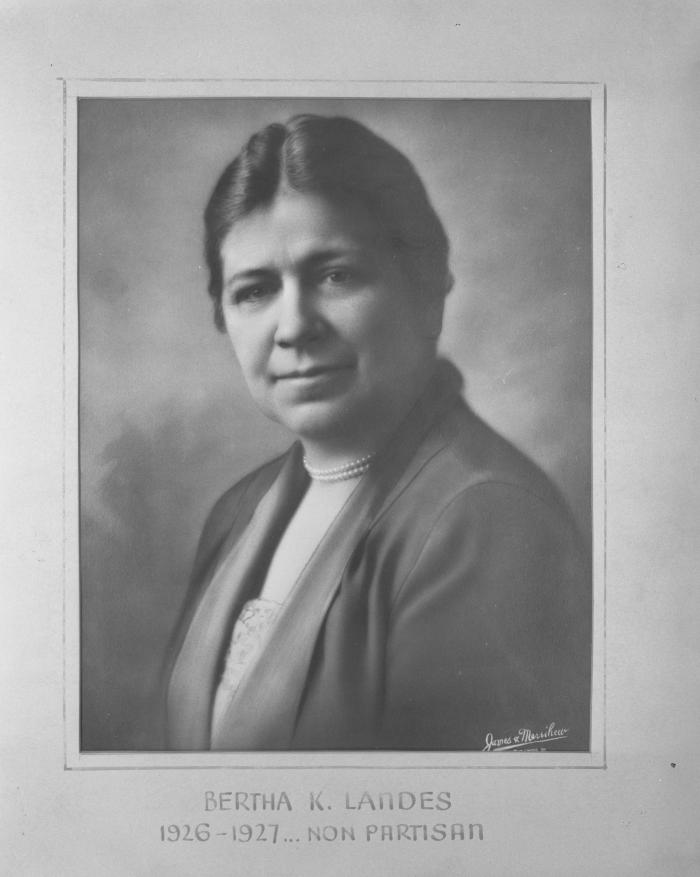
In the early 20th century, the campaign for women’s suffrage and activism around prohibition brought women into the public sphere. With the passage of the 19th Amendment in 1920 giving women the right to vote, the idea of women in the political arena was no longer unthinkable. In 1926, Seattle became the first major U.S. city to have a woman mayor when Bertha Knight Landes was elected. She took office on June 7, 1926, and served a single two-year term.
Landes moved to Seattle in 1895 when her husband Henry was appointed to the University of Washington faculty. A mother of three, she founded the Women’s City Club and was president of the Washington State League of Women Voters. Landes’s leadership was recognized early when she was appointed by the Mayor in 1921 to serve on a commission studying unemployment.
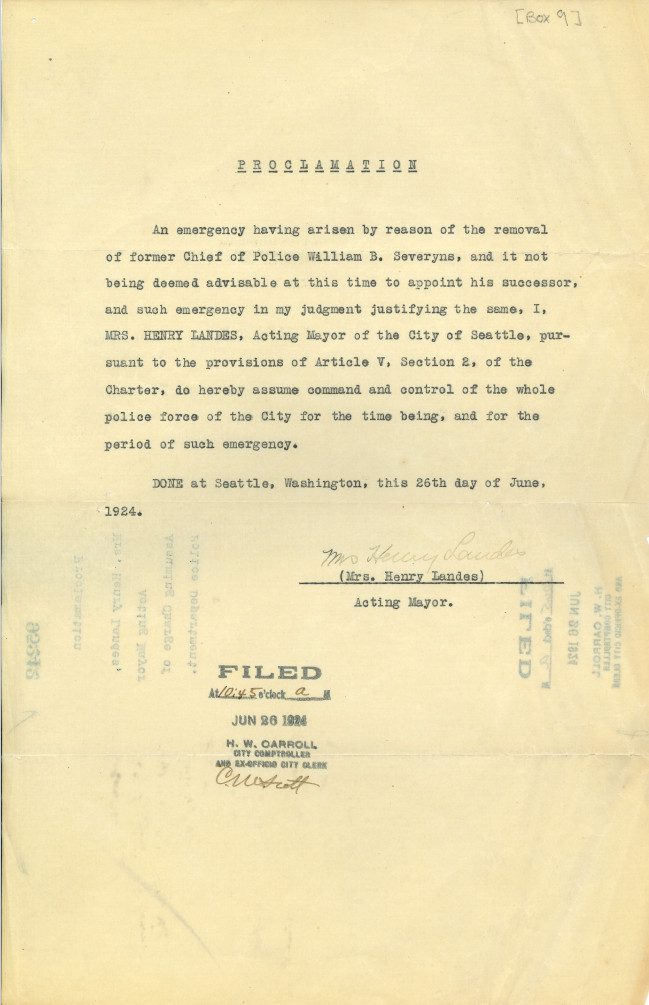
In 1922, Bertha Landes and Kathryn Miracle became the first women elected to Seattle City Council. Landes served as Council President after her reelection in 1924. She was acting mayor when Mayor Brown left town to attend the 1924 Democratic National Convention. Angry at what she saw as police corruption and lawless activity, Landes used her temporary mayoral powers to fire Police Chief William B. Severyns. She began her own law and order campaign, closing down illegal activities throughout the city, including lotteries, punchboards, and speakeasies. Upon his return to Seattle, Mayor Brown reinstated the Police Chief.

While on City Council, Landes supported city planning and zoning, improved public health and safety programs, and promoted social concerns such as hospitals and recreation programs. She continued this work as Mayor, encouraging the use of professional expertise in many areas, such as hiring by merit through a strengthened Civil Service Commission. She supported public ownership of utilities and led an unsuccessful push to get the City to adopt a city manager form of government. Landes countered the dominant business perspective with one that included caring for the City’s moral, social and physical environment. The legacy Landes left is one of using city government for civic betterment.
Landes wanted to be treated equally with men and called for public service to be gender-neutral: “Let us, while never forgetting our womanhood, drop all emphasis on sex, and put it on being public servants.” She despised being called “mayoress.”
When Landes lost her bid for re-election to Frank Edwards in 1928, she was asked about the future of women in politics. She said, “Women now wield considerable power along political lines and I believe each succeeding year for some time to come will find them wielding that power more effectively. But . . . at present men in general are not ready to yield to women the privilege and right of holding high political office.”

After leaving office, she wrote extensively for national magazines and encouraged other women to get involved in politics. In a 1929 Colliers article she wrote, “In politics it commonly takes a superior woman to overcome the handicap of traditional prejudice.” Landes continued to be active in the community in her post-mayoral years – for example, she oversaw 673 women who sewed garments for women and children to “help improve the unemployment situation” during the Depression.
Landes paved the way for other women like Mildred Powell, who served on City Council from 1935 to 1955. However, Seattle did not have another woman mayor until Jenny Durkan took office in 2017.